Unify Your Databases, including Firebase, CosmosDB, and DynamoDB
Length
" transform="translate(1.749 1.749)" width="10.501px"/></g></svg>)
Author
Guillaume Rigal
Published
It’s Connectuary: Unify all your data in One Backoffice. We now support Firebase, CosmosDB & DynamoDB
The Stakes in Ops: Why "Connectuary"?
Efficiency is about access. If your Operations team has to open five different tabs, like Stripe, HubSpot, a Postgres admin, an AWS-based console, just to solve one customer ticket, you have a problem.
Fragmented data creates friction. It slows down support, delays billing investigations, and frustrates internal users.
At Forest Admin, we believe the goal of a modern Backoffice is to eliminate this friction. It should be the Single Source of Truth where all your data meets, allowing your team to act instantly, without ALT-tabbing their life away.
Three new databases to get started: Firebase, CosmosDB, and DynamoDB
This week, we announced the integration of major cloud solutions like Firebase, CosmosDB, and DynamoDB. Three of the major cloud providers (Google, Azure and AWS) are now fully accessible from your Forest Admin workspace if you wish so.
And yes, this is on top of our existing support for PostgreSQL, MongoDB, MySQL, and many others (SQL and noSQL).
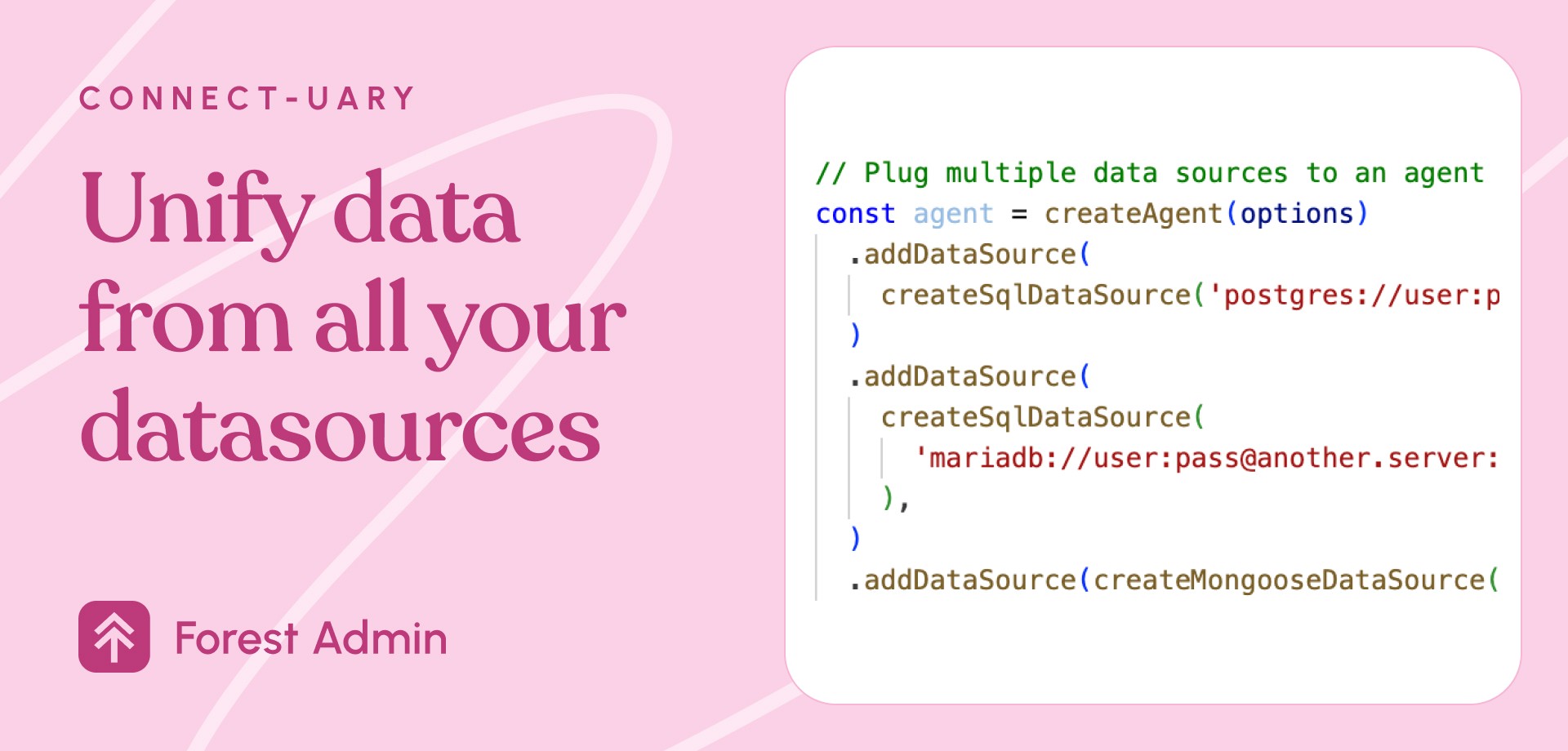
And because Forest Admin is built on a multi-datasource architecture, adding these new databases means you can instantly unify them with your existing stack and operating workspace.
Creating Context from Chaos, one datasource at the time
To have a powerful platform for operations, you need the capacity to connect to any data point and bring them together side by side.
Imagine your Operations Manager trying to solve a ticket. They shouldn't have to look at Payment data in one tab, Connection logs in another, and Account usage in a third.
To make faster decisions, they need Context. They need to see the Payment next to the Connection Log next to the Usage stat.
The "Smart Relationship" Magic to bind data together
Forest Admin allows you to plug different data sources together to build this context. We call them Smart Relationships. You can define relationships across different datasources. For the tech-savvy out there, it’s just like you would with a foreign key in SQL.
Link a User (in PostgreSQL)...
To their Activity Logs (in DynamoDB)...
And their Invoices (in Stripe).
No custom internal tools to build. No complex data pipelines. Just a unified interface that reflects the reality of your business. And makes it accessible in one view to your customer care agents.
So, ready to connect your stack?
Check out the docs on Data Sources and Relationships.
Need a specific datasource?
If you want to connect a tool we don't support yet, or need advice on unifying your stack: